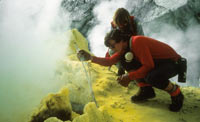
Geologists are scientists who study the matter that makes up the Earth. They also study the Earth’s history and the processes that have formed it. Geologists apply chemistry, biology, physics and other sciences to their work in the field and research in laboratories. Important subjects related to geology include physics, chemistry, biology, mathematics and computer science. Higher level courses related to geology include mineralogy, hydrogeology, sedimentology, palaeontology, physical geology and structural geology. Geographic information systems (GIS) and mapping skills are also important to geologists. Geologists are usually logical thinkers, good problem solvers and enjoy working outdoors. Those who choose geology as a career may work for private firms, non-profit organizations, academic institutions or governments. There are a large variety of disciplines geologists may specialize in including marine geology, pedology, volcanology, metamorphic petrology, geochemistry and geophysics. Geologists may study the behavior of rocks, magnetic principles, rock formations, groundwater, the ocean floor, fossils, oil exploration, volcanoes and more.
| | | | | | Science Careers | | | | | | | | | | Geologist | | | | | | |
|